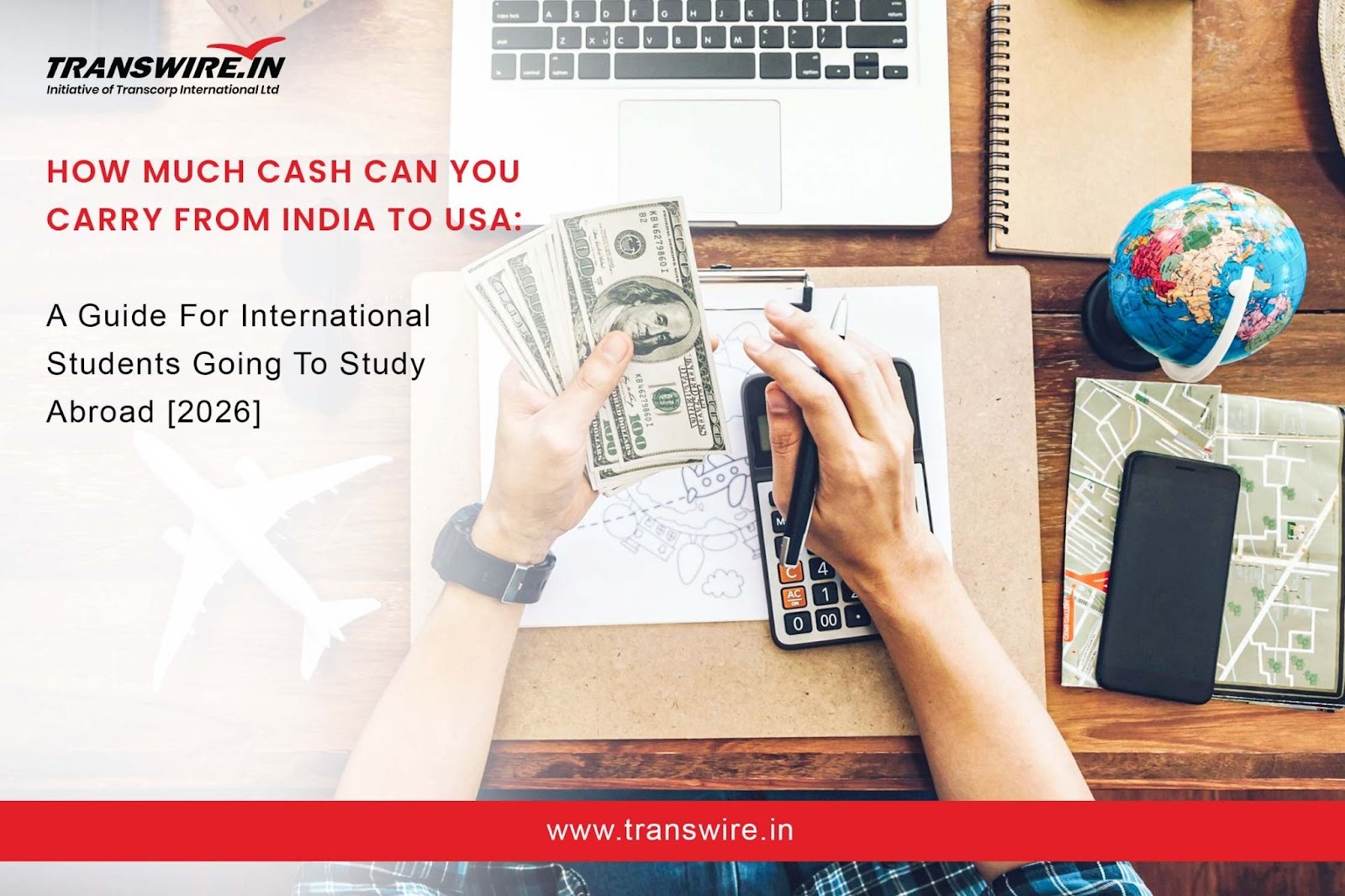
Coming to the United States to study is one thing, and spending your money wisely is as essential as packing your bags. Among the most frequently asked questions, the common question students want to know is: how much cash can you carry from India to the USA?
The amount you want to carry does not depend only on limits but rather on being knowledgeable about rules, risk avoidance, and making smart financial decisions within the first few days of your time in a foreign country.
Understanding How Much Cash You Can Carry from India to the USA
It is important for students to be aware of the legal boundaries and requirements before they travel. Excessive difficulty while carrying the handbag can cause inconvenience, whereas excessive carrying of money may pose unnecessary risk.
How much cash can I carry from India to the USA as a student?
If you have plans of travelling, the straightforward response to the cash limit from India to usa for students is:
- You can carry up to USD 3,000 in cash from India
- The rest of your funds should be in:
- Forex cards
- Bank transfers
- Digital payment methods
Keep the cash as your survival fund for those first few days, for your taxi fare, food, or in case of an emergency after landing.
Maximum cash allowed from India to the USA explained
The maximum cash allowed from India to USA depends not only on the amount but also on how it is carried.
- Cash (notes): limited for safety reasons
- Total foreign exchange: up to USD 250,000/year (under LRS)
- Proof of source is mandatory
In simple terms, you can move large amounts abroad, but not as physical cash.
RBI Rules for Carrying Cash Abroad for Study
Before travelling abroad with money, one should be aware that the Reserve Bank of India (RBI) imposes strict limits on the amount of cash and foreign exchange that students carry. Such regulations promote compliance with the law and safer, traceable financial practices.
- Students are allowed to remit USD 250,000 in a financial year under the Liberalised Remittance Scheme (LRS) to cover their education and living costs in foreign countries.
- Physical cash is usually limited to approximately USD 3,000 per trip, and the balance is to be transported via digital means.
- The rest should be brought in the form of forex cards, bank transfer, or traveller’s cheques.
- Some of the compulsory documents are a PAN card, a passport, a visa, and an admission letter.
- An outward remittance declaration should be made by submitting Form A2.
- Their large transactions (over 50,000) are to be made using NEFT, RTGS, or debit/credit cards, not in cash.
- Any transaction would be recorded under PAN to ensure that you do not exceed the yearly LRS limit.
The rules are designed to ensure that your international financial journey is a safer, more transparent, and more compliant experience.
US Laws on Carrying Cash – What You Must Know
Although you may be living by Indian rules, you have not fully made it without knowledge of U.S. rules. This is the most common mistake among students due to confusion.
How much cash can you carry from India to USA?
To students with the question of how much money can international students carry to USA, the answer is this:
- You can carry any amount of money into the U.S.
- But if it exceeds $10,000, you must declare it
This applies to:
- Cash
- Traveler’s cheques
- Monetary instruments
What happens if you carry more than $10,000?
If your money exceeds the limit:
- You must declare it using official forms
- Customs officers may ask about the source
If you don’t declare:
- Your money can be seized
- You may face penalties or delays
Declaring money is not illegal; hiding it is.
Best Way to Carry Money Abroad for Students
Taking money overseas is not only a matter of limits, but of the most secure and convenient mix of alternatives. Students ought to consider the balance among convenience, security, and accessibility so that they are not financially stressed upon arrival.
What is the best way to carry money abroad—cash, forex card, or credit card?
Here’s the smartest mix:
- Cash: For immediate expenses (limited amount)
- Forex card: For daily spending
- Bank transfer: For tuition and rent
No single method is enough since balance is key.
How to balance cash and digital money for safety
A safe and practical student strategy:
- $500–$2,000 in cash
- The majority of funds in the forex card
- Backup via bank transfer
This ensures:
- Accessibility
- Safety
- Flexibility
Best Forex Cards for Students Traveling to the USA
The safety and ease of use of Forex cards have made them one of the most preferred cards among international students. They help you save on daily expenses while keeping you safe if you carry a lot of cash.
Which is the best forex card for students traveling to the USA?
Choose a card that offers:
- Low exchange rate markup
- Easy reload options
- Global acceptance
- Mobile app tracking
Banks and fintech providers offer student-friendly options; compare before choosing.
Benefits of using forex cards over cash
Why are forex cards better?
- Safer than carrying large amounts of cash
- Fixed exchange rates
- Easy to block if lost
- Accepted worldwide
It’s like carrying a digital wallet instead of physical cash.
Smart Tips to Carry Money Safely While Traveling Abroad
No matter how you carry your cash, security must be your top concern when travelling outside the country. Basic precautions will ensure your safety and security and avoid unnecessary inconvenience.
Safety tips for carrying cash and cards internationally
Follow these simple tips:
- Split cash into different bags
- Keep emergency cash separate
- Store cards securely
- Keep digital backups
Common mistakes students make when carrying money abroad
Avoid these mistakes:
- Carrying too much cash
- Not declaring excess money
- Depending on one payment method
- Ignoring forex receipts
Small mistakes can lead to big trouble—stay prepared.
Smart Money Planning for Your USA Study Journey
When you want to know, “how much cash can you carry from India to USA,” You do not necessarily mean that you are going to be rule-following, but rather that you will make wiser financial decisions in your new life overseas. Although there is a legal limit, it is neither safe nor practical to carry a large amount of cash.
The most suitable solution would be to keep a minimum amount of cash to cover urgent needs and use secure methods, such as forex cards and bank transfers, for the rest. With the help of the proper balance, you not only remain on the right track but also begin your studying process calmly and without any fears
Begin your education without the stress of making international payments to the university, with TransWire international money transfer that is fast, safe, and RBI certified- ideal when it comes to tuition, living costs, and so on.
FAQ’s
1. How much cash can I carry from India to the USA as a student?
The amount of cash you can carry is about USD 3,000, which is allowed in India, and the rest must be in the form of forex cards or bank transfers, according to RBI regulations.
2. How much cash can you carry legally in the United States?
Legally, you can bring as much cash into the U.S. as you wish; however, it is advisable to disclose the cash (above 10,000) to customs.
3. What is the RBI limit for carrying foreign currency abroad for study?
Under the RBI’s Liberalised Remittance Scheme, students can remit or carry USD 250,000 per financial year for education and living costs abroad.
4. Is the $10,000 cash limit per person or per family when traveling to the USA?
The 10,000 declaration limit can be applied per family or household, provided the declaration is made jointly rather than individually.
5. How much money should an international student carry to the USA?
Ideally, students are expected to have between $500 and $3000 ready in cash for immediate expenses, while the remaining amount is meant to be held in secure forms such as forex cards or bank transfers.