Moving money overseas is no longer a matter of speed in which your transfer is completed but the amount that makes it to the receiver. A transfer of the same amount can quietly decrease the ultimate payout by variation in currency values even with the same amount of transfer. It is imperative to understand how exchange rate fluctuations, fees, and timing interact when you are willing to prevent unnecessary losses and make international remittance charges more effective. It is a simple practical guide, which dissects it all down, so that you make more intelligent overseas transfers with ease.
What Exchange Rates Really Mean in Overseas Remittances
On the simplest level, exchange rates establish the conversion of your money in one currency to another. However, in overseas remittances, they contribute a significantly larger role than most individuals are aware of – in most cases they can have more impact on the final figure than the visible fees.
What Is an Exchange Rate in an International Money Transfer?
An exchange rate refers to the price at which one currency is exchanged with another one in the course of a transfer. The exchange rate you get when you transfer money abroad is hardly what you can read on the internet.
Bank and remittance businesses often charge a percentage on the market rate, and this has a direct effect on the amount that your recipient gets even without the addition of fees.
What Are Exchange Rate Fluctuations?
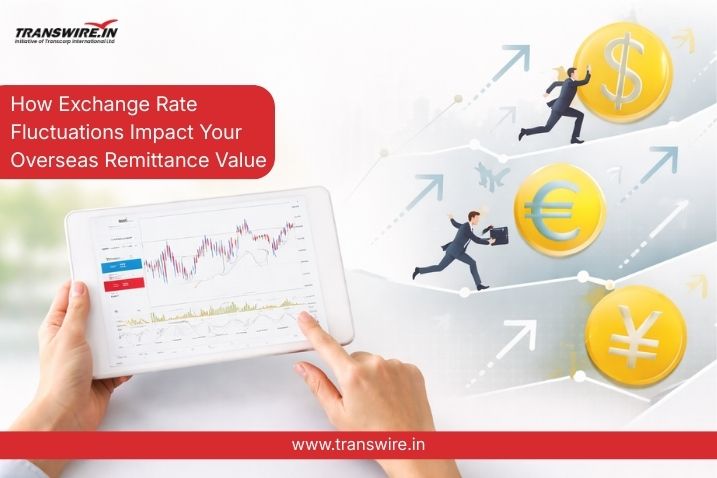
The steady increase and decrease in the currency values as dictated by market conditions is called the exchange rate fluctuations. The changes may occur on a daily basis or a number of times in a day.
To a consumer costing money in another country, this implies that money that is transmitted today can bring a different value tomorrow, simply because of the movement of rates.
Why Do Exchange Rates Fluctuate Every Time You Send Money?
Exchange rate varies due to the trade of the currencies in the world like commodities. They are constantly subject to demand, supply, and world opinion.
The forex rate fluctuations are subject to interest rates decisions, inflation, political activities and economic stability which in turn influence remittance pricing in real-time.
How Exchange Rate Fluctuations Affect Your Overseas Remittance Value
This is where theory becomes actual finances. The movements of the exchange rates do not simply appear differently on a screen but instead directly alter what your beneficiary obtains.
How Forex Rate Changes Reduce the Final Amount Received
Even a minimal change in the exchange rate can bear some visible difference particularly when there is a huge or regular transfer.
Considering this example, in case the rate fluctuates against you in between initiation regularity and processing, your recipient will receive less- despite you transmitting the identical quantity. These losses are cumulative over time.
Exchange Rates vs International Remittance Charges
Although most senders consider visible fees, exchange rates can usually affect the actual cost of a transfer at a significant impact. The following table explains clearly the differences in rates and charges on the total value of remittance.
| Cost Factor | Exchange Rate Impact | International Remittance Charges |
| Visibility | Often hidden in the rate | Clearly shown as fees |
| Frequency | Applies to every transfer | May apply once per transaction |
| Cost Impact | Can reduce final payout significantly | Usually fixed or predictable |
| User Control | Depends on timing & provider | Easier to compare upfront |
| Long-Term Effect | High for frequent transfers | Moderate over time |
Understanding Currency Conversion and Outward Remittance Charges
Other than the exchange rates, there are other overhead expenses that may lead to a decrease in your transfer value. Opening up on how these charges operate will assist you to identify where the money goes to waste.
What Are Currency Conversion Charges?
The hidden costs that are entrenched in the exchange rate itself are currency conversion charges. As an alternative to imposing a special fee, providers raise the charge slightly to their advantage.
This is what makes this cost less visible, yet it has a direct negative impact on how much your recipient gets.
 What Are Outward Remittance Charges and Who Pays Them?
Depending on the route of transfer, outward remittance charges can be bank service fee, correspondent bank fee or SWIFT related fee.
In other instances they are charged by the sender, others are charged by the amount transferred and as a result the beneficiary is only left with less.
When Is the Best Time to Send Money for a Better Exchange Rate?
There is no perfect time in which one should send money, but timing does count.
The exchange rates are more likely to vary in cases of major economic announcements or global events. When you do not need your transfer urgently, it can be a good idea to wait until you have a good exchange rate- at least with high value remittances.
Can You Lock an Exchange Rate Before Sending Money Overseas?
Certain remittance services will also provide an option of locking an exchange rate over a specific period.
This is the best alternative that would guard against the low rate surprises and is particularly handy with scheduled, certain payments like college fees or healthcare costs.
Do Money Transfer Apps Show Real-Time Exchange Rates?
Numerous sites promote live rates, yet one should know how the rates are implemented in the process of real transfer.
Real-Time Rates vs Applied Rates
The rate shown in an application can change regularly, however, the rate applied can vary because of processing delays or market fluctuations.
This distinction is usually where one can suffer unforeseen losses especially when the currency is experiencing a sharp movement.
 Apps vs Banks: Impact on Remittance Value
International transfer is provided by both apps and banks, but the prices of other products differ greatly. The following comparison shows the difference in their impact on the value of remittance.
| Comparison Area | Money Transfer Apps | Banks |
| Exchange Rate Transparency | Usually higher | Often bundled with margins |
| Processing Speed | Faster in many cases | Slower due to intermediaries |
| Fees Structure | Lower, more predictable | Higher and layered |
| User Experience | Digital-first, simple | Documentation-heavy |
| Impact on Final Value | Often better optimized | Can reduce payout |
How to Stay Ahead of Exchange Rate Fluctuations When Sending Money Abroad
Exchange rate risk management does not need any expertise but simply a systematic strategy. A practical step-by-step instruction on how to be in control is presented below.
Track Exchange Rates Regularly
The exchange rate fluctuates every day, even hourly. Monitoring trends will ensure that you do not invest money when the market is moving in a negative direction and it enhances decision-making.
Use Rate Alerts and Notifications
There are numerous sites that would enable you to follow a notification of exchange rates. Such notifications ensure that you take action when the market is on your side.
Plan Transfers Instead of Sending Urgently
Mechanical transfers can be very stressful and result in a need to accept an unfavorable rate. One can plan ahead and have the freedom, and minimize losses that can occur out of sudden exchange rate fluctuations.
Compare Providers Before Every Transfer
Various providers have varied rates and fee structure. Comparisons aid in better balancing speed, cost and value.
Split Large Transfers When Possible
In large amounts of remittance it is better to divide transfers on a few other days so that exposure to sharp changes in the value of the forex rate can be minimized and the average conversion value can be enhanced.
Final Takeaways – Maximizing Your Overseas Remittance Value
The exchange rates, conversion margins and fees all are used in the same way to find out the amount of money that actually gets to your recipient. Knowing how the international remittance charges depend on rates and timing, you will be able to prevent unnecessary losses and make better decisions.
When sending money through Transwire the customer is guaranteed of clear pricing, good exchange rates and processes that are in line with RBI- so you never guess what you are sending and what will be received by your beneficiary.
Choose Transwire for smarter overseas remittances and ensure more of your money reaches its destination.
FAQs For Exchange Rate Fluctuations
1. Why do exchange rates fluctuate every time you send money?
Exchange rates fluctuate because currency values change continuously based on global demand, interest rates, inflation, and economic or geopolitical events.
2. How do exchange rate fluctuations affect overseas money transfers?
Exchange rate fluctuations change the conversion value, which can increase or reduce the final amount received by the beneficiary without altering the amount sent.
3. What are currency conversion charges, and how do they affect remittance value?
Currency conversion charges are hidden margins built into exchange rates that lower the effective rate and reduce the beneficiary’s final payout.
4. When is the best time to send money to get a better exchange rate?
The best time to send money is during stable market periods while avoiding major economic announcements that cause sudden exchange rate volatility.
5. Can I lock an exchange rate before transferring money overseas?
Some remittance services allow temporary exchange rate locks, helping protect transfers from sudden currency fluctuations.